Number Three: A Smart Embroidery Choice for Small Business Branding
First Impression: Friendly, Flexible, and Built for Back to School Energy
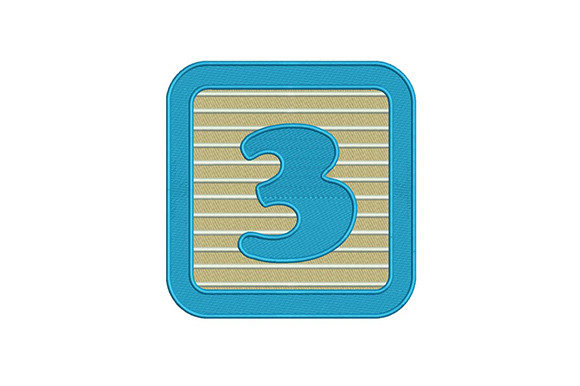
As an embroidery designer who’s digitized and stitched thousands of designs for small businesses—from indie bakeries to pet boutiques—I immediately read Number Three as warm, approachable, and intentionally versatile. Its title suggests clarity and intentionality—not just decoration, but a meaningful visual anchor. The description confirms it’s a high-quality machine embroidery design meant for children’s projects, but that doesn’t limit its commercial power. In fact, that playful-yet-structured energy makes Number Three ideal for brands that value authenticity, handmade charm, and subtle storytelling—think café aprons with “Est. 2023” stitched beside it, or boutique tote bags featuring Number Three as a signature accent next to a custom logo.
Where Number Three Shines in Real Small Business Merch
This design excels where many others falter: as a scalable brand element across diverse touchpoints. As an embroidered patch, Number Three reads cleanly at 2.5”–3.5”, holding shape without overcrowding. On staff uniforms or aprons, it works beautifully on chest pockets or sleeve cuffs—adding personality without competing with primary branding. For cap embroidery, it performs well on structured fronts or curved back panels when digitized with appropriate underlay and reduced density. On tote bags and reusable lunch sacks—key items for Back To School campaigns—it balances visibility and restraint, especially when paired with minimal typography.
Small business owners selling handmade products will appreciate how Number Three reinforces a crafted aesthetic. It’s not overly ornate, so it won’t clash with natural fabrics like canvas, linen, or organic cotton. And because it’s designed for apparel and room decor, its stitch density appears balanced—not so heavy that it stiffens lightweight fabrics, nor so light that it fades after repeated washing. That reliability directly supports customer trust: when your embroidered product holds up wash after wash, buyers associate your brand with quality and care.
Smart Placement & Where to Use With Intention
Like any strong design asset, Number Three rewards thoughtful application. Avoid placing it on highly curved surfaces (like deep baseball cap crowns) without testing first—subtle distortion can soften legibility. Likewise, if you’re stitching it smaller than 1.75”, inspect the inner spacing and outline definition closely; some versions of numeric embroidery lose crispness at tiny scales. Dark uniforms demand high-contrast thread colors—test black-on-navy or navy-on-charcoal before bulk production. And always consider fabric texture: dense terry cloth or bouclé may swallow fine details, so pair Number Three with smooth twills, poplins, or midweight denim for best results.
How Number Three Strengthens Your Brand Identity
For small businesses, consistency is currency—and Number Three functions as a flexible, repeatable motif that builds recognition over time. Used across aprons, tote bags, packaging tags, and even embroidered product labels, it becomes a quiet signature—like the “3” in a trio of seasonal collections, a founding year marker, or a nod to a core value (e.g., “Three Ingredients,” “Three Principles,” “Third Generation”). That repetition fosters visual consistency without feeling repetitive. Customers begin to recognize the shape, the rhythm, the balance—and that subconscious familiarity boosts engagement and recall. It also signals professionalism: choosing a well-digitized, commercially viable embroidery file shows intention behind every branded detail, elevating perceived product value far beyond DIY aesthetics.
Practical Designer Notes Before You Stitch
Before launching Number Three into production, follow these field-tested steps:
- Test in black and white first—this reveals contrast issues and helps assess silhouette strength across fabric types.
- Check small patch viability: resize to your target patch dimensions (e.g., 2” x 2”) and verify all curves and counters remain open and clean.
- Review thread color contrast, especially for dark or textured garments—light ecru or heather gray may outperform stark white on certain fabrics.
- Inspect spacing and jump stitches: tight internal angles need proper pull compensation to avoid thread nests on delicate fabrics.
- Confirm hoop size compatibility with your embroidery machine and intended garment placement—some versions may require larger hoops for optimal stabilization.
- Test on real fabric, not just stabilizer swatches—fabric drape, stretch, and weave dramatically affect final stitch appearance.
- Use appropriate stabilizer: cutaway for knits, tear-away for stable wovens, and fusible + tear-away for lightweight linens.
- Create a printable mockup for client approval—show Number Three scaled on an apron front, cap side, and tote bag corner to confirm visual harmony with other design assets.
- Compare alongside your existing logo, icons, and typography—does Number Three complement or compete? Does its weight and rhythm align with your brand voice?
- Verify commercial licensing before using Number Three on merchandise for resale—this is non-negotiable for Etsy sellers, craft studios, and retail partners.
Final Thought: More Than a Number—A Branding Partner
Number Three isn’t just another digital embroidery file. It’s a quietly confident design asset—flexible enough for Back To School tote bags and precise enough for embroidered product labels on handmade soap or ceramic mugs. For small business owners and embroidery shops alike, it represents smart visual strategy: simple in form, rich in function, and deeply compatible with the handmade product ethos customers increasingly seek. When stitched with care and placed with purpose, Number Three doesn’t just decorate—it communicates, connects, and endures.